Pork Leg Shank Roast
Pork Leg Shank Roast
Flavor: 4 Out Of 5
Alternative Names: Fresh Ham Shank End, Pork Leg Shank Half
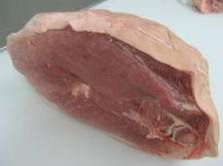
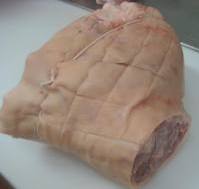
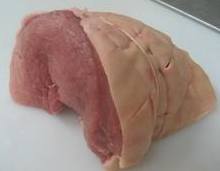
The shank is the lower portion of the leg, below the knee joint. The shank makes up half the leg, the upper portion of the leg is called the butt. Although the shank may not be quite as tender as the butt end, many prefer the shank for roast pork recipes because it is easier to carve.
Cooking Instructions
Pork Leg Shank Roast
We have experimented cooking a pork roast leg with different methods, with and without liquid, low and high temperatures, some good results and not so good.
Came across a method in a test kitchen book I was reading and decided to give it a try. The recipe called for submerging the roast in a brine for 8 to 24 hours and applying a glaze during the cooking of the leg.
Simply superb, we have never cooked a pork leg roast another way since finding this method, tender and juicy, a great oven pork roast recipe for entertaining.
If you wish to skip the 8-24 hour brine process start with step 1, skip steps 2&3 and then proceed with step 4.
1. First you must score the skin on the pork leg shank. This is done by carefully slicing through the skin and fat with a knife without cutting into the meat. Cut across diagonally and then cut across horizontally creating 1 inch diamond cuts across the skin.
2. In a stockpot or bucket dissolve 4 cups of kosher salt or 2 cups of table salt and 3 cups of dark or light brown sugar in 1 gallon(4 liters) of hot tap water.
Add 2 garlic gloves lightly crushed and peeled, 8-10 bay leaves and 1 gallon(4 liters) of cold water. Submerge the roast in the brine and refrigerate 8-24 hours.
3. Remove roast from the brine, rinse under cold water and pat dry with a paper towel.
4. Place the roast skin side up on a rack in a roasting pan. Let the roast sit uncovered at room temperature for 1 hour.
5. Adjust the oven rack to the lowest position and heat oven to 500 degrees.
6. Roast the leg at 500 degrees unglazed for the first 20 minutes. Once the oven is turned down to 350 degrees begin to brush the roast with the glaze and continue to do so every 45 minutes, until the center of the roast is 145-150 degrees on an instant-read thermometer, about 2.5-3 hours.
7. Tent the roast with foil for 30 minutes, temperature should rise 155-160 degrees on the thermometer.
  INSTANT-READ
THERMOMETER
#1 Best Seller
INSTANT-READ
THERMOMETER
#1 Best Seller
|
Below is a cooking chart for pork roast. Remember you should always use an instant-read thermometer to check the doneness of a roast. The internal temperature will rise about 10 degrees during resting time, remove the roast 10 degrees before desired doneness.
| Doneness | Description | Meat Thermometer Reading |
| Medium | Pink throughout | 145-150 degrees |
| Medium-Well | Slightly pink in center | 150-160 degrees |
| Well-Done | Beige-pink throughout | 160-170 degrees |
It is not recommended pork be cooked less than medium doneness.
Return To Home Page


US To Metric System Chart
Oven Temperatures
Fahrenheit (°F) Celsius (°C)
125° 52°
150° 66°
175° 80°
200° 93°
225° 107°
250° 121°
275° 135°
300° 149°
325° 163°
350° 177°
375° 190°
400° 205°
425° 218°
450° 232°
475° 246°
500° 260°
TheMeatSource.com is a participant in the Amazon Services LLC Associates Program, an affiliate advertising program designed to provide a means for sites to earn advertising fees by advertising and linking to amazon.com


